The County of San Mateo has added a translation feature developed by Google Translate to assist web visitors in understanding information on this website in a variety of foreign languages. Please be aware that Google Translate, a free third party service which the County does not control, provides automated computer translations that may not give you an exact translation. The County cannot guarantee the accuracy of translations through Google Translate so translations should not be considered exact and only used as a rough guide. Anyone relying on information obtained from Google Translate does so at his or her own risk. The County disclaims and will not accept any liability for damages or losses of any kind caused by the use of the Google Translate feature.
FOOD WASTE PREVENTION
Cutting down on landfill waste.
Food Waste Prevention
According to the United States Environmental Protection Agency (EPA), one-third of all food in the United States ends up as waste, rather than as food for human consumption. This unfortunate reality results in an alarming amount of climate change-causing greenhouse gas emissions, as food that decomposes in the landfills results in methane gas being released into the atmosphere. Methane gas is a greenhouse gas more potent than carbon dioxide.
Reducing food waste not only helps curb climate change, but also saves your household money, and ensures that food is used to feed your family – not our landfills. Visit the EPA’s “Preventing Food Waste at Home” page to learn important ways you can reduce food waste, including meal planning and shopping tips, storage tips, and cooking and food preparation tips.
You can also reduce food waste by learning more about how to decipher and decode date labels. Many foods — with the exception of infant formula — can still be consumed past the date stamped on the package if stored properly. You can use your senses — sight and smell — to observe whether food is truly “expired” or not. Of course, if your food has visible signs of spoilage — like mold growth or a foul smell — you should compost it rather than eating it. New laws are being introduced and implemented at the state and local levels to address product expiration mislabeling — stay tuned to learn more!
Does learning about how reducing food waste can save money, and fight climate change, inspire you?
If you’d like to get involved in reducing food waste, and help give back to your local community, you can volunteer with a Food Recovery Organization (FRO)!
Organizations across San Mateo County work hard every day to recover unsold surplus edible food from businesses and organizations for distribution to those in need in our communities. In accordance with the County’s Edible Food Recovery Ordinance, large restaurants and businesses must donate their surplus edible food to FROs. These organizations welcome support from volunteers looking to help pick up and deliver food donations, prepare grocery boxes, and support food distribution events. The following are organizations you can support today.
Volunteer with a Food Recovery Organization
Compost Food Scraps
We know that it is unrealistic to get food waste down to zero. But we do aim to get 100% of food and food scraps out of our landfills. Whatever food or food scraps can’t be consumed should be composted. Your composted food scraps are turned into compost, a nutrient-dense soil amendment made from decomposed plant matter and food waste, that can be applied to soil to improve its fertility and moisture retention. Composting is now the law for most residents and businesses — but it’s easy to do. Contact your hauler to set up a composting program or to request assistance, such as sorting trainings and signage.
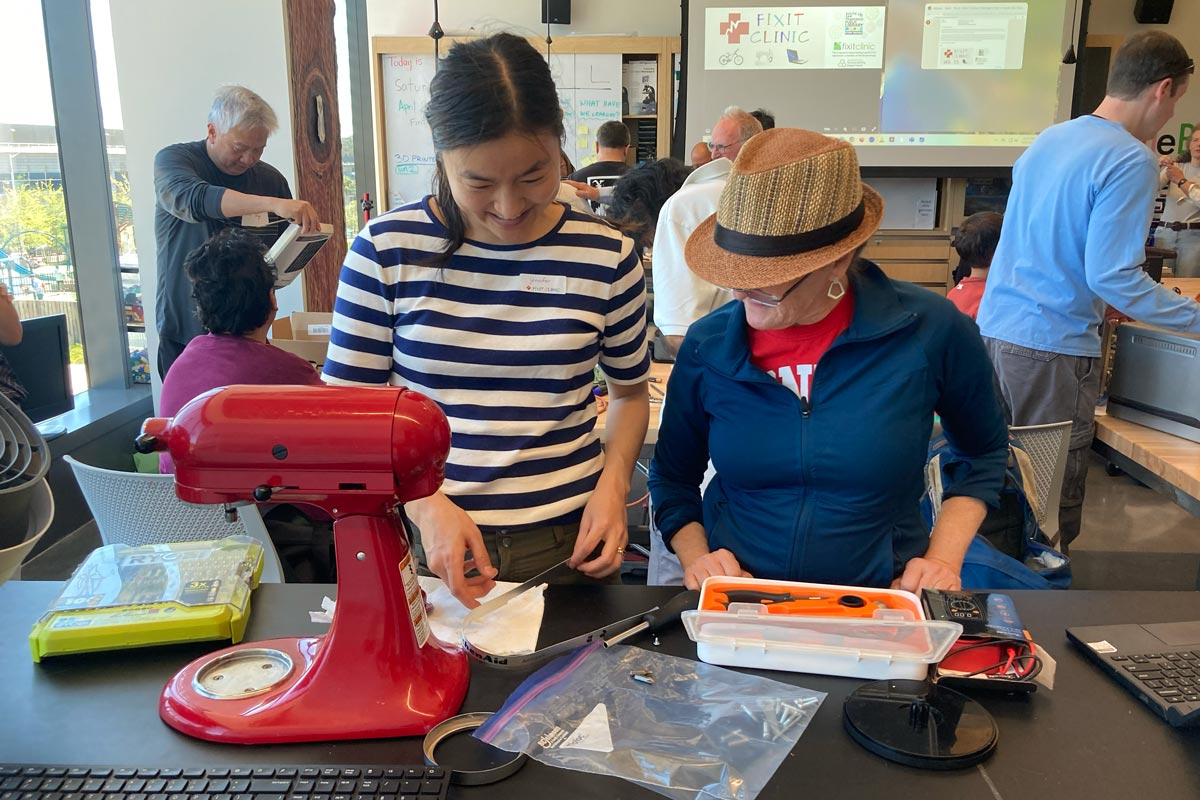
Find your DIY community at the Library! Repair-inclined neighbors will meet in the Makerspace to informally troubleshoot, disassemble, and diagnose broken things together.